
NGO workshop guide: Designing effective workshops for Nonprofit Organisations
Why workshops are important for NGOs
Whether it's for stakeholder alignment, setting a digital strategy, or a collaborative planning session, Liquid Light does love a good workshop! And while they are always useful for any sector, workshops play an even more critical role in NGO decision-making, stakeholder alignment, and project planning.
It’s worth saying here that by “NGO” I’m generalising a broad sector. But from the clients we've worked with, we do see a common thread. Whether they are international development agencies, not-for-profit organisations, member associations, environmental activist groups, or United Nations agencies, to name a few. Despite their diverse missions and structures, these organisations share similar challenges:
- Complex missions that require input from multiple departments: From program implementation to fundraising, communications to finance, each department brings crucial perspectives that need alignment.
- Diverse (often numerous) stakeholders with different priorities: Donors, beneficiaries, partners, board members, and staff may all have different expectations and needs from a workshop process.
- Geographically dispersed teams: With teams working across multiple countries or regions, bringing everyone together (virtually or physically) requires careful planning.
- Limited resources: With tight budgets and stretched capacity, workshops must deliver clear value and actionable outcomes.
These shared challenges demand thoughtful workshop design approaches.
Why run a workshop?
Workshops have earned a mixed reputation stemming from how they're designed and facilitated. A well-crafted workshop creates space for everyone to contribute — not just the loudest voices in the room. International development workshops and nonprofit facilitation sessions are particularly valuable when you want to:
- Align diverse stakeholders on digital strategy across international offices
- Gather requirements for member platforms or donor user journeys
- Translate mission and values into digital experiences
- Develop a cohesive visual brand identity that resonates across cultures
- Create alignment between technical teams and non-technical programme staff
- … and well anything really that needs structured input from key people
In the post below, I’d like to outline some key tips and considerations to run an effective workshop.
Virtual Workshop Considerations for NGOs
With many of our clients geographically dispersed, we were already running virtual NGO workshops and remote nonprofit facilitation sessions long before COVID made this the norm. So although it’s always lovely to meet new people face to face, we’ve found that virtual workshops are very effective – if run correctly.
Virtual workshops enable participants to be more comfortable in their own environment, they can use separate screens for research and it’s easier to include geographically dispersed team members. If participants are joining from around the world, make sure to choose a time that suits everyone otherwise you’ll have people joining after bedtime!
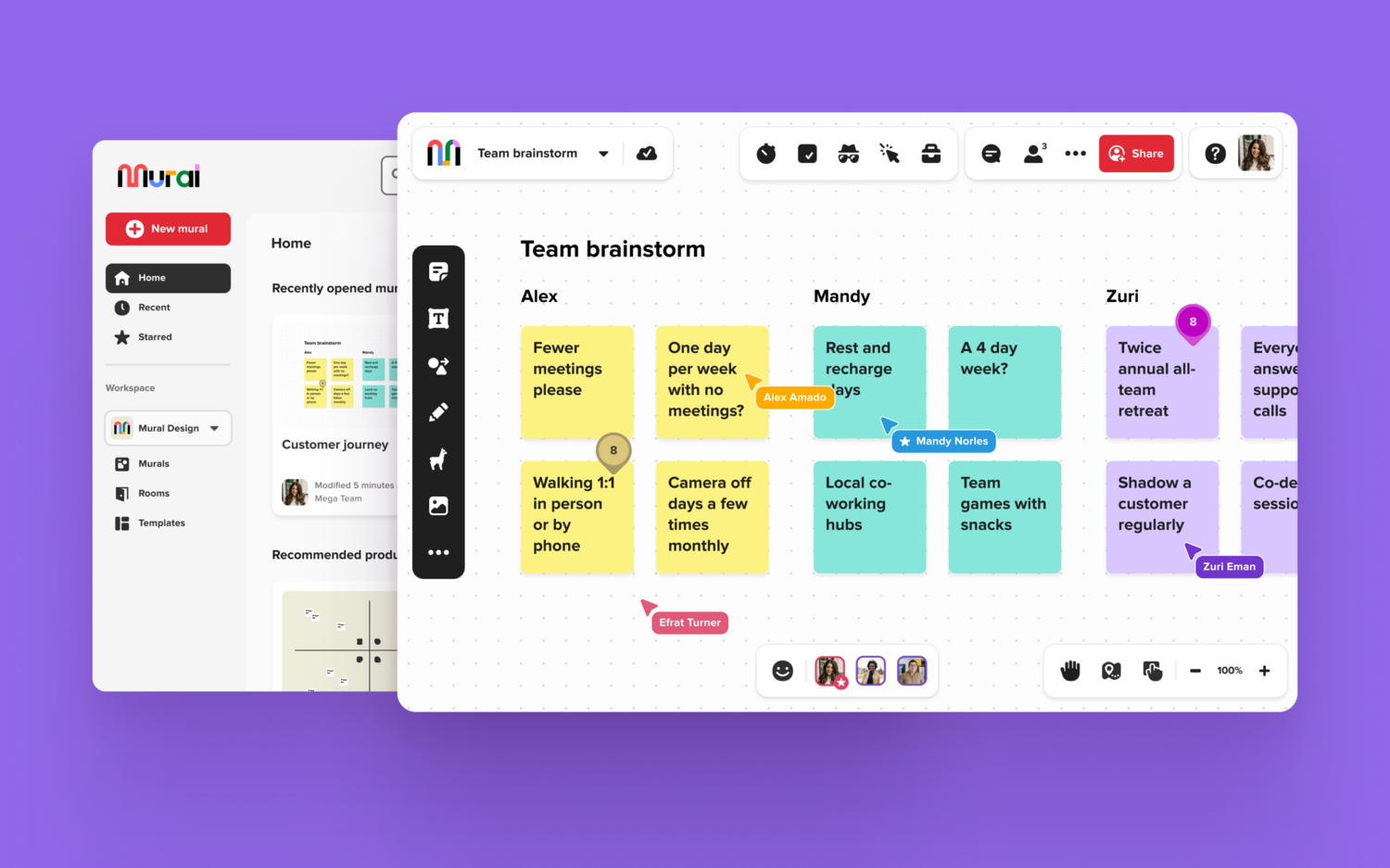
To avoid wasting time and awkward moments, ensure everyone can access a virtual whiteboard before the call. We often send out a blank virtual board before the call as we prefer to get a client’s initial reaction rather than seeing the exercises beforehand. We prefer Mural for its balance of features and simplicity.
Pre-defined breaks should be included for all workshops, but plan for more frequent breaks that are agreed upon ahead of time for when they are virtual, and keep each session to less than 3 hours (including the break).
Key takeaway
Do: Test all technology access before the workshop day and schedule frequent breaks.
Don't: Assume everyone is comfortable with the virtual tools or can maintain focus for hours without breaks.
Making decisions with various stakeholders
Making decisions in the workshop can be challenging, especially with numerous and often passionate stakeholders involved in an NGO workshop. However, it is invaluable to come to a decision when the deadline is tight and if you have brought everyone together from different countries then you need to take advantage of the opportunity.
There’s no huge secret to this, but we’ve found that an effective solution to breaking deadlocks is to appoint a decision maker beforehand. If a decision needs to be made everyone must be comfortable the person appointed will act for the good of the group. For example, in one recent workshop, we established upfront that the Executive Director would make final decisions based on the team's input, which kept the process moving despite differing opinions.
Key takeaway
Do: Designate a decision-maker before the workshop begins to avoid deadlock if decisions need to be made in the workshop.
Don't: Leave the workshop without clear next steps or ownership of decisions.
What’s the optimal number of people for a nonprofit workshop?
We find that around 7 participants create the ideal balance between diverse perspectives and productive conversation.
If there are more people that need to be involved (and there are often more in member association workshops or large nonprofit facilitation settings), then run multiple smaller workshops instead of one large session.
We were recently tasked with creating user personas and needed to listen to around 30 different people. We conducted three separate workshops synthesising the findings to identify common themes and unique differences. On a practical level we did this by using different coloured sticky notes for each group then rationalising the sticky notes into a new board.
It’s useful to mix the groups up rather than having everyone from the same department. For example, each group might have a representative from the communications, programme or finance team rather than having separate workshops for each one. If someone needs to be in all the workshops, they should only contribute to one and then be an observer in the others.
Using surveys to get wider input
Surveys are also a great way to supplement workshops for wider input when there are simply too many people to attend. This could be an entirely different article, but my advice is to think about how you’ll use the data from the survey and let that dictate what you might ask:
- Qualitative questions: These are more subjective, and give you a general flavour of the research. E.g. “what do you feel about…”
- Quantitative questions: These allow you to create objective, statistical inferences. E.g. “which of the following best describes…”
By their nature, the qualitative answers aren’t as straightforward to feedback to the workshop group as the quantitative answers. However, just by reading through these and making notes of common threads or interesting points you’ll be able to refer to this insight at points during the workshop.
Quantitative answers can more easily be turned into charts and added to the board as discussion points or to back up decisions with data.
Key takeaway
Do: Aim for around 7 participants per workshop - run multiple sessions if needed and supplement with surveys if you have a wider audience group.
Don't: Try to accommodate too many voices in a single session, which dilutes participation.
Creating Balanced Participation
The workshops that Liquid Light runs often have diverse participants from different countries and backgrounds. It’s important therefore to recognise that not everyone will feel comfortable sharing opinions, especially if the group is over dominated by louder voices (often the chair person or head of communications).
Note and Vote
The "note and vote" technique from the Google Ventures design sprint methodology ensures all voices are heard. For this, each participant independently writes their ideas or thoughts down on a sticky note. They then share these with the group, talking through each one. The group then uses stickers to vote which ideas that they want to discuss further. This is particularly useful in groups with hierarchical dynamics; it prevents people from being swayed by others before forming their own opinion.
We often come across participants who would prefer to “back channel” to us. This is best avoided, but it’s important to recognise that some people aren’t comfortable speaking, no matter how friendly the group environment. The important thing is to make sure that the feedback is diplomatically fed back into the group.
Honest feedback without hurting feelings
It’s important to consider the feelings of those participating in workshops as they may have been involved in previous related work that is deemed unsuccessful. For example, if you are discussing the current brand identity, the people responsible (often an in-house designer or comms person) are likely to be part of the session. In which case, getting honest feedback from other participants may be difficult as they may worry about hurting feelings. Here you must put everyone at ease by framing the conversation around evolving needs rather than criticising past work. You can also acknowledge how incremental changes can lead to inconsistency over time or give some other reasons why something may not have worked previously.
Key takeaway
Do: Frame discussions around evolving needs and future improvements.
Don't: Structure exercises that might publicly criticise someone's previous work.
The key to effective workshops for nonprofit organisations
Workshops should create a tangible reference of the conversations. Don’t let these insights disappear, never to be revisited. Summarising the workshop into a document helps, but can feel disconnected from the session itself, which is why it’s important to keep good notes on the workshop within the virtual white board (or remember to take photographs if the workshop is in person). You can also transcribe the workshops and use AI to create a queryable knowledge base. This creates an ongoing resource that can be queried months after the workshop has ended.
Well-designed workshops can significantly drive an NGO's mission. Whether facilitating international development workshops or helping with digital transformation for member associations, the collaborative approach helps people align around key issues. They provide an environment for different departments to have a voice. And they are the first step in defining mandated action points that genuinely drive organisational change.
At Liquid Light, our 25+ years working with organisations such as the World Health Organization and other international NGOs has given us unique insight into this sector. We’ve developed expertise in facilitating workshops such as NGO digital transformation and nonprofit brand workshops that deliver meaningful results. By implementing these practical techniques, you too can also transform routine meetings into collaborative sessions that drive decision making.
-

Matt Keogh
Creative Director